Hierarchical game agent · Minecraft

TaskFrame

Connecting Task-Level Planning with Frame-Level Control for Game Agents

Plan once per task. Act at every frame.

Guangzhi Wang1*, Junfu Pu1*†, Yiran Wang1*, Xingyilang Yin2*, Honghao Chen1, Cheng Cheng1, Lingen Li3, Yinan Zhou4, Jiarui Wu3, Yinuo Jiang5, Hongbo Jin6, Xiaodong Cun1,7✉, Ying Shan1 1Tencent ARC Lab   2University of Macau   3The Chinese University of Hong Kong   4City University of Hong Kong   5Huazhong University of Science and Technology   6Peking University   7Great Bay University * Equal contribution   † Project lead   ✉ Corresponding author
0%
average kill success
vs. 31% for JARVIS-VLA-7B
0B
vision-language planner
runs once per task
0 Hz
frame-level control
an action every game step
~0 h
human gameplay
native keyboard & mouse
0
training stages
plan → control → align
01

Overview

Task-level reasoning and frame-level control operate at different frequencies. Understanding a scene and ordering subgoals needs a large model; executing those subgoals needs a lightweight controller that reacts to every new frame.

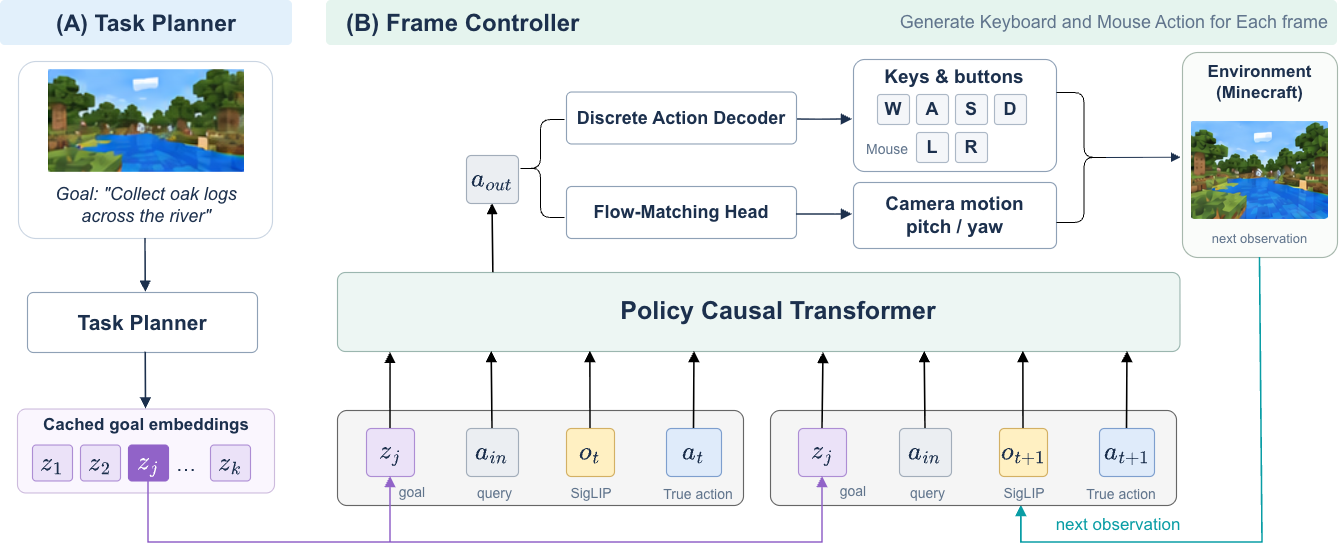
TaskFrame connects the two through planner-produced goal representations. A vision-language task planner decomposes a high-level instruction into an ordered sequence of atomic goals, each terminated by a special goal token. The hidden states at these tokens are cached and passed to a lightweight frame controller, which combines the active goal embedding with recent frames to emit discrete keyboard and mouse-button actions and continuous camera motion at every game step. The large planner stays outside the frame-level control loop.

Task planner

Qwen3.5-9B trained with SFT and dependency-aware GRPO for visually grounded decomposition.

z

Goal tokens

Hidden states of special goal tokens give continuous goal embeddings, cached and reused across control steps.

Frame controller

Causal Transformer with a hybrid head: autoregressive keys & buttons + flow-matching camera.
Overview of TaskFrame
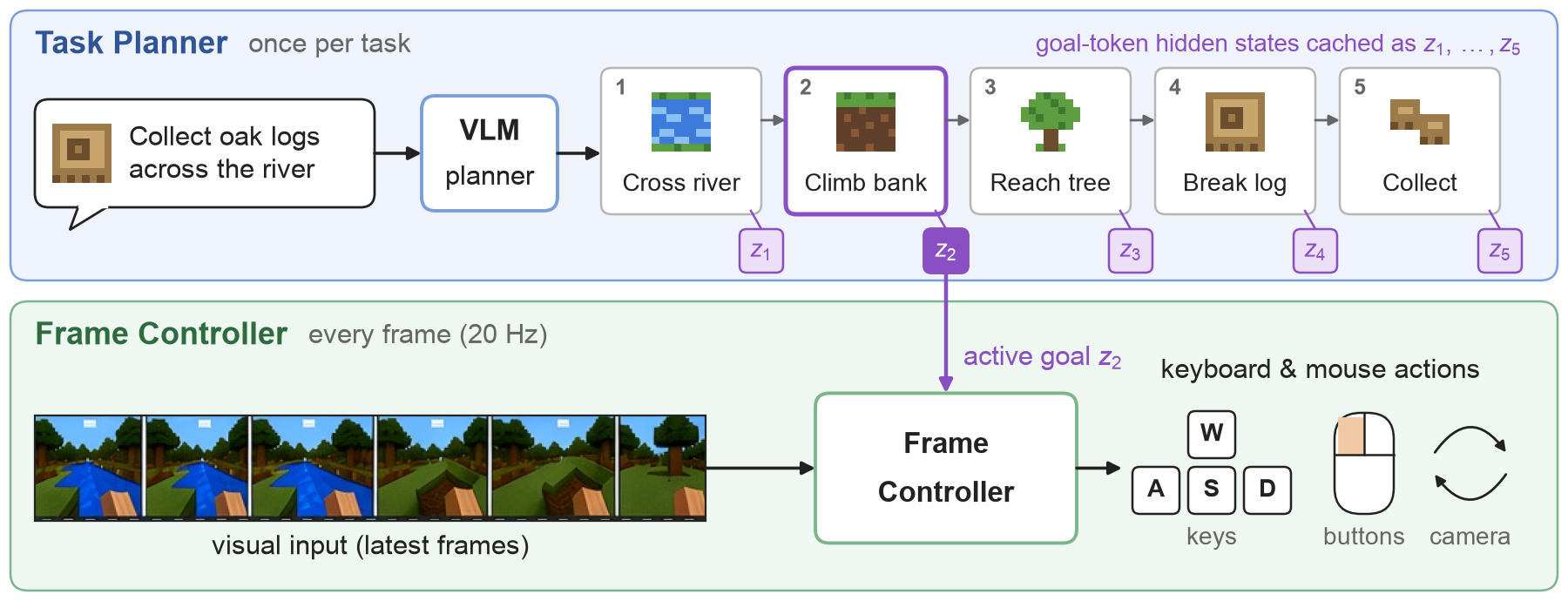
Overview of TaskFrame. Once per task, the task planner decomposes a high-level instruction into ordered atomic goals, each terminated by a special goal token whose hidden state is cached as a goal embedding. At every frame, the frame controller takes the embedding of the active goal and the latest visual input and emits native keyboard-and-mouse actions.
02

Two clocks, one agent

Multi-rate inference: the planner decodes the plan once; the controller acts at every frame using only the cached embedding of the active goal.

Task rate once per task
Collect oak logs across the river
VLMplanner
Frame rate 20 Hz
Framecontroller
z1
W
ASD
space
camera Δψ, Δθ
planner calls0
controller steps0
active goal–

Schematic animation of Sec. 3.4, not a recorded rollout. Key presses are illustrative. As in the paper, switching to the next atomic goal is supplied by an external execution protocol.

03

Method

TaskFrame architecture
(A) Task Planner. A vision-language model decomposes a high-level goal into an ordered sequence of atomic goals, each terminated by a special goal token; their hidden states are cached as goal embeddings z1, …, zk. (B) Frame Controller. A per-frame autoregressive policy. Each frame consumes the active goal embedding, an action-query token, a SigLIP image token, and the action, which only later frames attend to. The action-output token is decoded into discrete keyboard and mouse-button presses and continuous camera motion.

Three-stage training

Starting from Qwen3.5-9B, the planner is trained for visually grounded instruction decomposition on the hierarchical annotations of GameHorizon Suite: first with supervised fine-tuning, then refined with dependency-aware GRPO that rewards step-count agreement and necessary precedence relations separately.

LLM + connector trainedvision encoder frozen
Task planner
Frame controller

The controller is pretrained on atomic-segment gameplay with native keyboard-and-mouse actions. A frozen, generic vision-language model (Qwen3.5-9B) encodes the frame at the start of each window together with its atomic instruction, terminated by the same goal token, to produce the goal embedding.

controller trainedgeneric goal encoder frozen
Generic VLM encoder
Frame controller

The generic encoder is replaced with the GRPO-trained planner, augmented with LoRA adapters in every Transformer block. The action objective updates all controller parameters and the adapters, while base planner weights stay frozen. The adapted planner is the single planner used at inference, for both decomposition and goal embeddings.

controller + LoRA trainedbase planner frozen
Task planner + LoRA
Frame controller

Dependency-aware GRPO

A reference plan records one execution sequence, but several orderings may be valid. Generated steps are aligned to reference steps by Hungarian assignment, and the reward separates dependency satisfaction S_{\mathrm{dep}} over annotated must-precede pairs from conventional-order agreement S_{\mathrm{conv}} over the remaining pairs:

The 0.8/0.2 split is derived from the dependency annotation statistics of GameHorizon Suite.

Reward playground toy example

Reorder or drop steps of a toy plan and watch the reward above respond. Arrows mark the illustrative must-precede dependencies D.

    R_k1.00
    S_{\mathrm{dep}}1.00
    S_{\mathrm{conv}}1.00
    R1.00

    Goal representations

    Each atomic goal is terminated by a special goal token \tau. The hidden state at the j-th goal token summarizes the goal in the context of the observation, the instruction, and the preceding steps:

    The decoded language supports supervision and evaluation, while the controller consumes only z_j.

    Hybrid action head

    The action-output token is decoded by two heads: a small autoregressive decoder for discrete keys and mouse buttons, and a lightweight flow-matching head for continuous camera motion (yaw and pitch in degrees), which avoids discretizing small corrections and can represent several plausible directions.

    26key classes
    4button classes
    T = 21frames ≈ 1 s
    04

    Results

    Closed-loop control in Minecraft

    Success rate (%) on atomic tasks over 3 evaluation seeds (12 episodes per kill task, 6 per mining task, per seed). Protocol of JARVIS-VLA and MCU in MineStudio.

    Instruction decomposition

    SSF1 is evaluated without a supplied step count on 2.1K held-out plans; Task2 of GameHorizon Suite measures step ordering on 250 questions. General-purpose models are evaluated zero-shot.

    Goal conditioning in closed loop

    Kill success (%) when only the supplied goal is changed; 48 episodes per task in each of three seeds.

    Planner & controller roles

    Offline action prediction on held-out gameplay with high-level goals.

    Camera head

    Camera MAE (°) on held-out gameplay; same data and schedule, only the camera head differs.

    05

    Closed-loop rollouts

    Recorded first-person episodes from closed-loop Minecraft evaluation. Combat clips are successful TaskFrame rollouts: the controller turns, closes in, and keeps attacking until the target is gone. Oak is a successful mining episode from the aligned controller.

    kill cow
    SUCCESS

    Same scene, different agents

    06

    Limitations

    07

    Citation

    @article{wang2026taskframe,
      title   = {TaskFrame: Connecting Task-Level Planning with Frame-Level Control for Game Agents},
      author  = {Wang, Guangzhi and Pu, Junfu and Wang, Yiran and Yin, Xingyilang and Chen, Honghao and
                 Cheng, Cheng and Li, Lingen and Zhou, Yinan and Wu, Jiarui and Jiang, Yinuo and
                 Jin, Hongbo and Cun, Xiaodong and Shan, Ying},
      journal = {arXiv preprint},
      year    = {2026}
    }